Category: Default

  • Hackathon 2026

    Hackathon on Telemedicine & Digital Health Innovation

    Jan 23-24, 2026

    Kathmandu (Hybrid)

    Nepal Health Hack 2026 is a national innovation hackathon organized as part of the 4th National Telemedicine & 1st National Digital Health Conference. It brings together technologists, health professionals, designers, students, researchers, and entrepreneurs to co-create practical digital health solutions for Nepal’s real-world challenges.

    This hackathon is problem-first, impact-driven, and grounded in Nepal’s health system realities—especially low-resource and underserved settings.

    Why Nepal Health Hack?

    Nepal’s healthcare challenges are complex—geography, workforce shortages, fragmented systems, and inequitable access. Technology alone won’t fix this.
    Smart, contextual, and usable innovation might.

    Nepal Health Hack is designed to:

    • Bridge health and technology communities
    • Move beyond ideas to validated, feasible solutions
    • Encourage collaboration across disciplines
    • Support innovations that can scale, integrate, or pilot in Nepal

    Hackathon Tracks (Themes)

    Accepted Areas of Challenge’s

    Health Equity & Rural Access

    Problem:
    Over 79% of Nepal’s population lives in rural areas facing resource gaps. Providers work in isolation without specialist access.
    SCOpe:

    Clinical decision support for frontline providers

    Teleconsultation & referral coordination

    Tools for Community Health Workers (CHWs)

    Multilingual, low-bandwidth health solutions

    Air Quality & Respiratory Health

    Problem:
    Kathmandu’s PM2.5 levels regularly exceed safe limits. Real-time data exist but isn’t actionable for citizens or providers
    SCOpe:

    Exposure awareness and prevention tools

    Decision-support for respiratory diseases

    Citizen-facing and provider-facing applications

    Linking environmental data to health action

    Grassroots Care Coordination

    Problem:
    Facilities rely on paper registers that fragment care. Existing EHR’s are resource heavy for rural settings.
    SCOpe:

    Lightweight, offline-first digital health records

    Care coordination over data-heavy EHRs

    Designs for high-patient-load environments

    Solutions that work on basic devices and unstable power

    Who Can Participate?

    Nepal Health Hack is open to:

    • Doctors, nurses, and public health professionals
    • Students and early-career professionals
    • Startups, researchers, and innovators
    • Software developers & engineers
    • Solution Designers and Data Scientists

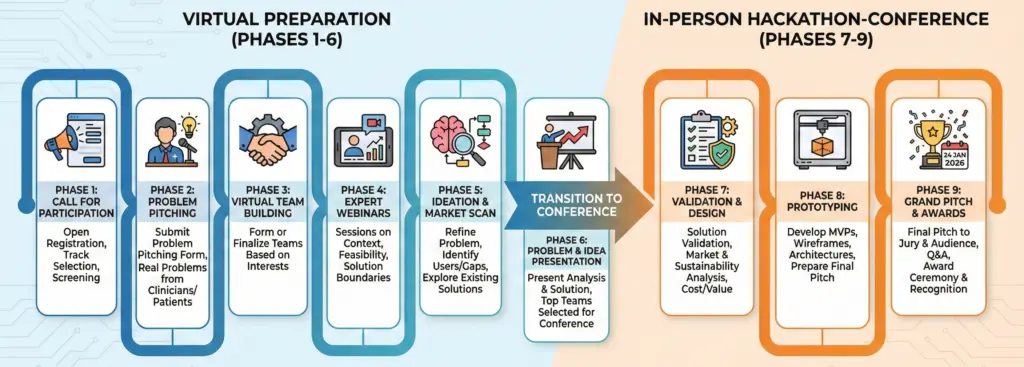
    Hackathon Format & Process

    What Participants Gain

    • Mentorship from health, technology, and policy experts
    • Hands-on experience solving national health challenges
    • Exposure at Nepal’s premier digital health conference
    • Networking with policymakers, implementers, and partners
    • The Selected Hackathon / Research Paper Presentation Finalists will be given free entry to entire conference

    How to Apply

  • Call for Abstracts

    4th National Telemedicine & 1st National Digital Health Conference

    23–24 January 2026 | Kathmandu, Nepal

    About the Call

    The Telemedicine Society of Nepal (TMSoN) invites students, researchers, practitioners, and innovators to submit abstracts based on your original research for the 4th National Telemedicine and 1st National Digital Health Conference.

    The Call for Abstracts focuses on telemedicine, digital health, and health informatics, with an emphasis on practical experiences, applied research, and solutions relevant to Nepal and similar low- and middle-income settings.

    Conference Themes

    • Telemedicine and remote care, Impacts, challenges, etc
    • Telemedicine Models and Virtual Care Delivery
    • Digital Health Systems, Platforms, and Architectures
    • Health Informatics, Data Analytics, and Clinical Decision Support
    • Artificial Intelligence and Emerging Technologies in Healthcare
    • Interoperability, Standards, and Health Information Exchange
    • Digital Health Policy, Governance, Ethics, and Regulation

    Important Dates

    ActivityTimeline
    Call for Abstract Opens20 December 2025
    Abstract Submission Deadline05 January, 2026
    Abstract Acceptance Notification07 January 2026
    Final Presentation Slide Submission 20 January 2026
    Conference Presentation24 January 2026

    Abstract Selection and Presentation

    All submitted Abstract will undergo a review by a dedicated Review Panel appointed by the Organizing Committee. The panel will evaluate submissions based on relevance to the conference themes, originality, clarity, methodological soundness, and potential impact on telemedicine and digital health practice or policy.

    Based on this review, the most promising Abstracts will be selected for oral presentation during the conference.

    Guideline for Authors

    1. Submission Process

    To maintain high academic standards while ensuring accessibility for all participants, the selection process follows these guidelines:

    • Abstract Submission (Required for Presentation) All interested authors must first submit a 250-word structured abstract for initial screening. This abstract will be used to select the highest-quality research work submissions for the conference.
    • Full Paper Submission (Optional & Encouraged) Authors of the selected abstracts will be encouraged to develop their work into a full manuscript (2,500–3,500 words) excluding references. While not required for the conference presentation due to time constraints, the organizing committee will guide authors to refine these papers for submission to international peer-reviewed journals.

    2. Abstract Requirements

    Your abstract is your “audition.” It must be concise and structured under the following headings:

    • Background: The problem or gap being addressed.
    • Methods: How the research or pilot project was conducted.
    • Results: Key findings or data-driven outcomes.
    • Conclusions: The impact on Nepal’s digital health future.

    Word Limit: 250 words maximum. Format: Microsoft Word or PDF. Font & Style: Times New Roman, 12pt, Double-spaced.

    3. Full Paper Structure

    Authors of top-ranked abstracts are invited to develop a full manuscript. This document should follow a professional academic format to facilitate future publication in collaboration with Nepal Telemedicine Society:

    1. Title Page: Full title, author names, affiliations, and contact details.
    2. Introduction: This section should provide the background and context of the research to demonstrate its significance. It must then identify a specific problem or “gap” in current knowledge and conclude by stating the clear objectives of your study.
    3. Methodology: Detailed technical or clinical design, including digital tools (e.g., EMR, telemedicine platforms).
    4. Results: Clear data presentation using tables and charts.
    5. Discussion: Interpretation of findings and practical recommendations for policymakers.
    6. References: Adhere strictly to APA style (7th Edition) for all in-text citations and the final reference list.

  • Conference Registration Details

    Registration Information and Fees

    Registration Fee Structure

    Registration Type

    Fee (NPR)

    Description

    Early Bird

    NPR 12,000

    Available until 02 January, 2026

    Regular Registration

    NPR 15,000

    Standard rate applicable from 3 January 2026 onwards

    Student Registration

    NPR 7,500

    Discounted rate for full-time students. Valid student ID required at check-in.

    One Day Registration

    NPR 7,500

    Access for one selected day of the conference (23 or 24 January).

    What Your Registration Includes

    The following benefits are included with all types of Registration fees.

    Full Access to All Sessions: Entry to all keynotes, high-level policy panels, hands-on workshops, and research showcase sessions across both conference days.

    Conference Materials: A complete delegate kit including the official program, writing stationery, and related conference information.

    Networking and Hospitality: Daily Lunch and scheduled tea/coffee breaks.


    Payment Methods

    Important Notice: We do not accept cash or payment of the registration fee at the conference site for local attendees. Registration fee must be paid in advance.

    1. Payment via QR Code (Preferred Method)

    The easiest and most efficient way to pay your registration fee is through digital banking/mobile wallets in Nepal.

    • Please complete your registration form.
    • The payment QR Code will be available on the final page of the registration form, immediately after you submit your details.
    • Scan the QR code using your preferred mobile banking application or digital wallet to complete the payment.
    • Upon completion of your registration, the conference secretariat will send you a confirmation email.

    2. International Participants

    For International Participants, we will accept payment of the registration fee in NPR on-site at the registration desk.


    Refund and Cancellation Policy

    All cancellation requests must be received in writing via email to conference@tms.org.np. Refunds will be processed according to the following schedule, calculated from the conference start date (January 23, 2026):

    Refund Amount

    Cancellation Timeline

    Full Refund

    30 days or more prior (On or before December 24, 2025)

    50% Refund

    15 days to 29 days prior (December 25, 2025 – January 7, 2026)

    No Refund

    Less than 15 days prior (After January 7, 2026)

Skip to content